
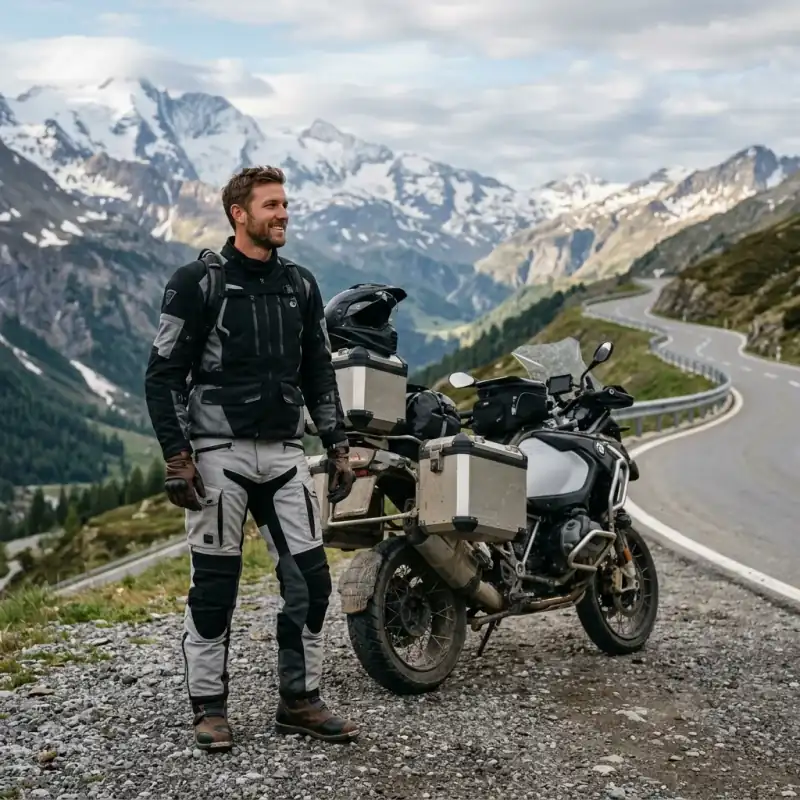
A cheap drop-liner pant and a $900 laminated one can carry the same “waterproof” label and behave nothing alike in a day of rain. That gap is the whole story. Adventure pants are the piece of kit most riders skip. They’ll spend on a jacket, a helmet, the right gloves and proper boots, then ride in jeans, and it’s the wrong place to save. Your legs hit the road first in most lowsides, and wet legs end a riding day faster than wet anything else.
This guide covers the one spec that decides how a pair of ADV pants performs, laminate versus drop-liner waterproofing, then the pair to buy for your budget and climate, from an under-$200 textile to $900 GORE-TEX Pro. The picks are chosen on the makers’ specifications and published reviews; we haven’t tested them.
Klim Carlsbad pants
Best all-round ADV pants for most riders: GORE-TEX and CE Level 2 armour without the Pro-line price.
Check Klim Carlsbad pants on Amazon →The One Spec That Matters: Laminate vs Drop-Liner
Before any product, understand this, because it explains every price difference below. Waterproof ADV pants do the job one of two ways:
- Drop-liner (Alpinestars Drystar, a removable GORE-TEX liner): a separate waterproof membrane sits under the outer shell. The shell soaks up water and gets heavy, but the layer beneath keeps you dry. Cheaper, often more versatile in heat (you can sometimes pull the liner out), and perfectly good for mixed riding.
- Laminate (laminated GORE-TEX and similar): the membrane is bonded to the shell, so the outer fabric can’t wet out. The pants stay light, dry fast, and stay waterproof through hours of rain, not just a shower. This is what you’re paying for in premium pants.
If you tour for weeks in real weather, laminate earns its keep. If you ride mixed conditions and want to spend less, a good drop-liner is the smart buy. Keep that distinction in mind and the lineup below sorts itself out.
Adventure Pants Compared — Side by Side
6 ADV Pants — Side by Side
| Pants | Waterproofing | Climate | Price |
|---|---|---|---|
| Best All-RoundKlim Carlsbad pants | Laminate GORE-TEX | 3–4 season | $$$ |
| PremiumKlim Badlands Pro pants | GORE-TEX Pro | 3–4 season | $$$$ |
| Alpinestars Bogota Pro Drystar pants | Drystar layer (in or over) | 4 season | $$$ |
| Alpinestars Andes V4 Drystar pants | Drop-liner Drystar | 3–4 season | $$ |
| Rev'It Sand 5 H2O pants | Removable liner | Hot / summer | $$$ |
| Tourmaster Trek pants | Aqua-Barrier liner | 3 season | $ |
1. Klim Carlsbad — Best All-Round ADV Pants

The Klim Carlsbad pants ($659.99 at Klim US, 16 October 2026) sit where price and performance cross: a GORE-TEX shell on Klim’s FPL400 chassis, with 630D Cordura overlays in the abrasion zones, tough enough for real adventure use without the weight and price of the Pro line. They’re CE AA rated and come with Klim Rogue CE Level 2 hip and knee armour.
What makes them work on the road is the ventilation. Two big thigh vents open straight onto you through the laminated shell, which is why a four-season pant like this copes with warm days better than its waterproofing suggests. The knee armor is adjustable so it stays over your knee, and they’re cut to go over adventure boots. Paired with the matching Carlsbad jacket from the adventure jackets guide, it’s a head-to-toe setup for most European touring.
The trade-off is price — these aren’t cheap, and they’re overkill if you only ride sunny weekends. But for the rider who does real distance in changeable weather and wants one pair to do it all, the Carlsbad is the pick.
Disclosure: some links below are affiliate links. If you buy through them we may earn a small commission at no extra cost to you.
Check Klim Carlsbad pants on Amazon →
- GORE-TEX shell, CE AA
- Big thigh vents
- Rogue CE Level 2 hip and adjustable knee armor
- Matches the Carlsbad jacket
- Expensive for occasional riders
- Overkill for fair-weather use
2. Klim Badlands Pro — The Toughest, Driest Pants Made

If money is no object, the Klim Badlands Pro pants ($899.99 at Klim US) are the top of the list: a three-layer GORE-TEX Pro shell, Superfabric on the knees, 630D Cordura on the seat and boot panels, leather on the inner knees for grip, and Rogue EXP CE Level 2 hip and knee armour. The A3 version ($1,099.99) adds Vectran fabric for abrasion and cut resistance.
They’re built for weeks of rain and hard use, with big vents for the heat, and they pair with the Badlands Pro jacket. The catch is the price, and most riders don’t need this much pant.
Check Klim Badlands Pro pants on Amazon →
- Three-layer GORE-TEX Pro shell
- Superfabric knees, leather inner knees
- Rogue EXP CE Level 2 hip and knee armour
- Big vents for hot climates
- $899.99 ($1,099.99 for the A3)
- More pant than most riders need
3. Alpinestars Bogota Pro Drystar — Four-Season Flexibility for Less

The Alpinestars Bogota Pro Drystar pants take a different route to four-season use without Klim money. The Drystar waterproof layer is a laminated liner you can wear inside the pants or over them as a rain layer, plus a detachable thermal liner for cold days. Worn on the outside, it keeps the shell dry the way a laminate does; worn inside, it behaves like a drop-liner.
They’re a touch more road-touring in character than the off-road-focused Klims, which suits the rider doing big tarmac miles with the occasional gravel detour. Armor is solid and the fit accommodates layering for cold mornings. There’s a women’s version too. The Alpinestars Stella Bogota Pro — cut for a female rider rather than just sized down, which matters for armor placement.

At about $410 on Amazon US (the women’s Stella version about $345, October 2026), that in-or-over flexibility is the value story here. They don’t have the bombproof abrasion panels of the Badlands Pro, but for most touring that’s a trade worth making.
Check Alpinestars Bogota Pro on Amazon →
- Laminated Drystar — stays light in the rain
- True four-season touring pant
- Women's Stella version available
- Half the price of premium GORE-TEX
- Less abrasion-focused than the Klims
- More road-touring than hard-enduro
4. Alpinestars Andes V4 Drystar — Best Value

The Alpinestars Andes V4 Drystar pants are the value sweet spot, and the natural partner to the Andes V3 gloves a lot of riders already own. These use a drop-liner Drystar membrane rather than a laminate, so the shell wets out in heavy rain, but the layer underneath keeps you dry, and they cost about $300 (Amazon US, October 2026).
What you get for the money is a good all-rounder: a stretch shell that moves with you, Nucleon Flex Plus CE Level 1 knee armor, and a fit that works for everyday riding and light touring alike. It suits a rider buying their first proper ADV setup who doesn’t want to spend a fortune finding out whether they’re into it.
What you give up is the drop-liner’s wet-out in heavy rain and slightly less ventilation than the premium pants. But pound for pound, this is the most pant for the money in the lineup.
Check Alpinestars Andes V4 on Amazon →
- About $300 for a real ADV pant
- Stretch shell, comfortable all day
- CE1 knee armor included
- Pairs with the Andes glove family
- Drop-liner wets out in heavy rain
- Less ventilation than premium pants
5. Rev’It Sand 5 H2O — Best for Hot Weather

When it’s hot, a sealed four-season pant is misery. The Rev’It Sand 5 H2O pants ($429.99 at REV’IT US, October 2026), which replaced the Sand 4 H2O in 2025, take the other route: a well-ventilated ADV pant with a removable waterproof H2O liner you carry for the rare shower rather than wear all day.
They share the Sand name with the Rev’It Sand 4 gloves (the gloves are still the Sand 4), so it’s an easy matched hot-weather set. On a 35°C day in Spain or Greece these are the pants to be wearing; if you ride mostly in hot climates, pick them over the four-season options above.
The trade-off is the opposite of the others: this is a warm-weather pant first, so for cold, wet touring it asks you to manage the liner. For its intended job, hot, dry adventure riding, nothing here is more comfortable.
Check Rev’It Sand 5 H2O pants on Amazon →
- Hot-weather ventilation
- Removable waterproof H2O liner
- Pairs with the Rev'It Sand 4 gloves
- Best comfort in real heat
- Liner management for wet days
- Not a cold-weather touring pant
6. Tourmaster Trek — Best Budget Pants

At $175.99 on Tourmaster’s own site ($219.99 list), the Tourmaster Trek pants prove you don’t need to spend a fortune to ride protected and dry. A tough 600D and 1000D ripstop shell, an Aqua-Barrier waterproof zip-out liner, a zip-out thermal liner, and adjustable CE Level 1 knee armor. The fundamentals are all here.
They suit a new rider, or anyone who wants real protection without premium money, and they pair with the Trek jacket for a complete budget textile suit. Don’t expect laminate-grade waterproofing or all-day vents: this is functional kit, not a flagship.
If your budget is the deciding factor, buy these and ride, rather than riding in jeans while you save for something fancier. Protected now beats premium later.
Check Tourmaster Trek pants on Amazon →
- ~$176–220 — real protection, real budget
- Tough ripstop shell, CE1 knee armor
- Waterproof liner included
- Pairs with the Trek jacket
- Liner waterproofing, not laminate
- Modest ventilation
How to Choose: A Quick Buying Guide
- Waterproofing: laminate for serious wet-weather touring; drop-liner or a removable liner for mixed and hot-weather riding (see the FAQ for the full explainer).
- Armor: prioritise CE Level 2 where it’s offered, but more importantly choose pants with adjustable knee armor so it stays in place. Hip armor is often optional; add it.
- Climate: be honest about where you ride. A four-season pant in constant heat is miserable; a summer pant in the cold and wet is dangerous. Match the pant to your weather, not to the spec sheet.
- Boot cut: decide over-the-boot or under-the-boot before you buy, and match it to your actual boots.
- Fit and layering: leave room for a base layer in winter and, if you ride cold, a heated liner; a slightly roomier pant earns that space back in November.
For the rest of the kit, the adventure jackets guide covers the matching top half, and the adventure helmets guide finishes the top end.
Disclosure: Some links in this article are affiliate links. If you buy gear through them, we may earn a small commission at no extra cost to you. It never changes what you pay.
A note on the prices: Klim and REV’IT figures are the makers’ US list prices; Alpinestars figures are Amazon US prices for the linked listing; the Tourmaster price is from Tourmaster’s site. Read in October 2026; the figure on the linked product page is the one that counts.
Frequently Asked Questions
What's the difference between laminate and drop-liner motorcycle pants?
It's the single most important spec in ADV pants. A laminate (laminated GORE-TEX, for example) bonds the waterproof membrane to the outer shell, so the shell itself can't soak up water — it stays light and dries fast, and the pants stay waterproof even in hours of rain. A drop-liner (like Alpinestars' Drystar or a removable GORE-TEX liner) puts a separate membrane underneath the shell; the outer fabric wets out and gets heavy, but the inner layer keeps you dry, and these pants are usually cheaper and more versatile in the heat because you can sometimes remove the liner. For genuine multi-day touring in wet climates, laminate is worth the money. For mixed riding and hot weather, a good drop-liner is the smarter, cheaper choice.
Do I need CE Level 1 or CE Level 2 armor in motorcycle pants?
CE Level 2 armor absorbs more impact energy than Level 1 (it transmits less force in the standardized test), so it's the safer choice if your pants come with it or let you upgrade — most premium ADV pants ship with Level 2 hip and knee armor or take it as an option. Level 1 is still real, certified protection and is fine for lower-speed and budget setups. The bigger real-world issue is armor staying in place: look for adjustable, height-positionable knee armor, because an armor pad that slides off your knee in a crash protects nothing regardless of its rating.
Should adventure pants go over or under my boots?
Most dedicated ADV pants are cut to go over the boot, which seals out rain running down your leg and lets you get them on and off without removing your boots — handy at a fuel stop. Touring-oriented or more road-biased pants are often cut narrower to tuck into the boot. Neither is wrong; just match the pant to your boots. If you ride tall adventure boots, an over-the-boot cut with an adjustable lower-leg gusset is the most practical. Check the cut before buying — a boots-over pant tucked into boots looks and seals badly, and vice versa.
Are expensive GORE-TEX pants actually worth it over budget waterproof pants?
For occasional, fair-weather riding, no — an under-$200 four-season textile with a waterproof liner will keep you dry on a wet afternoon and protected in a fall. The premium money buys three things: pants that stay waterproof through hours of hard rain instead of a shower, a shell that's lighter and far more abrasion-resistant (GORE-TEX Pro, Superfabric, Cordura), and ventilation that actually flows so you're not choosing between soaked-from-rain and soaked-from-sweat. If you tour for weeks at a time in all weather, that's worth $500–$900. If you ride sunny weekends, it isn't.
Can I wear adventure motorcycle pants in hot weather?
Yes, but match the pant to the climate. Four-season laminate pants like the Klim Carlsbad have large thigh and rear vents that move real air once you're rolling, so they cope with warm days better than they look. For hot, dry riding, a ventilated pant such as the Rev'It Sand 5 H2O, with a removable waterproof liner you carry for the rare shower, is far more comfortable. Riding a heavy, sealed four-season pant in 35°C heat is miserable; that's exactly why the hot-weather pick exists in this guide.