
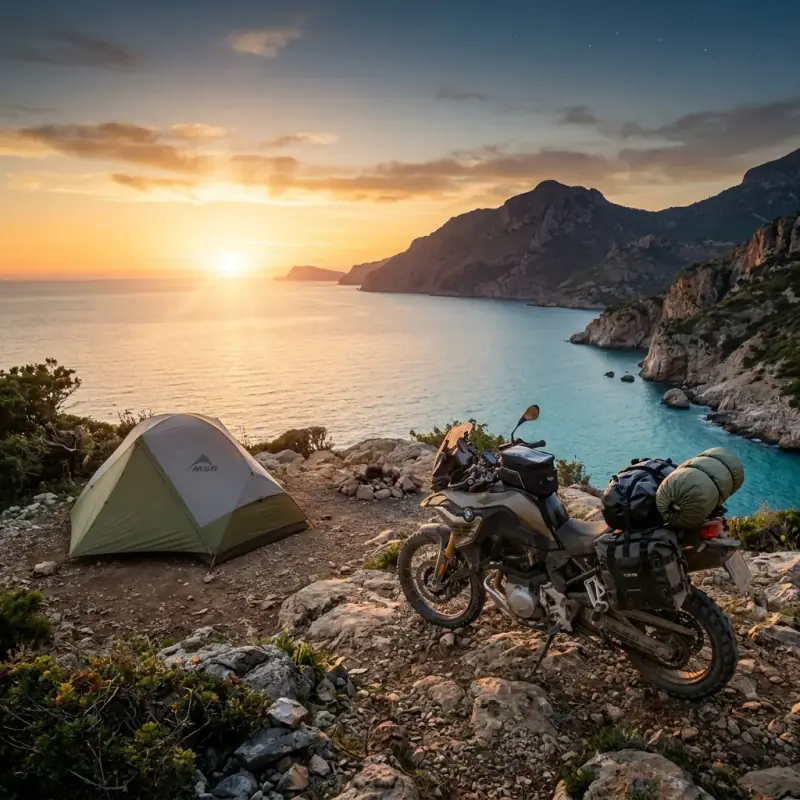
Adventure motorcycle camping is two skills stacked on top of each other: riding a loaded bike to somewhere remote, and being self-sufficient once you stop. Most guides cover one piece — a tent review, a route write-up, a packing list, and leave you to assemble the whole picture yourself. This guide walks through every decision that goes into riding out to a quiet bay or a mountain pass and sleeping there, in order, and links to the deep dive on each one when you want the detail.
The order: what bike, what to wear, how to carry it, what to sleep in, how to navigate, where it’s legal to camp, what to do when something breaks, and which roads are worth all of the above.
The Shape of the Trip
On a self-sufficient motorcycle camping trip, one weak piece undoes the rest. A perfect tent is useless if your luggage ruins the bike’s handling on the descent to the campsite. The best navigation kit doesn’t help if you can’t recover the bike after a drop on a loose climb. The skill is balancing the whole system (bike, gear, weight, shelter, navigation and route) against how you actually ride and where you actually go.
The rest of this guide takes those pieces one at a time, roughly in the order you’d think about them when planning a trip: the machine, what you wear, what you carry, where you sleep, how you eat, how you find your way, how you stay running and safe, and finally the payoff. The routes.
1. Choosing the Bike
The bike is the foundation, and the single most useful principle is that weight matters more than power. A bike you can pick up alone on a loose climb after a low-speed drop is worth far more on a real trip than thirty extra horsepower you’ll rarely use.
Beginners should start from their skill and the terrain they’ll ride. The best beginner adventure motorcycles for 2026 covers the lightweight, forgiving machines that build confidence without punishing mistakes, and shorter riders have a separate set of constraints worth understanding in the best ADV bikes for short riders guide, where seat height, standover geometry, and recovery weight matter more than the brochure number. The same guide has a section for women riders on reach and fit beyond seat height.
When you’re ready to compare the middleweights that dominate serious adventure riding, start with the full 650–900cc field, then let the head-to-heads do the heavy lifting: Yamaha Ténéré 700 vs Honda Africa Twin, KTM 890 Adventure R vs Ténéré 700. For specific machines, there’s a Royal Enfield Himalayan 450 review, and a BMW R 1300 GS Adventure review for riders looking at the flagship end. If your trips lean toward big mileage on tarmac, the best motorcycles for long-distance touring frames the decision around comfort and range rather than off-road agility.
2. Protective Riding Gear
Gear is the layer between you and the road, and on a long trip it has to do more than protect. It has to keep you dry, let you walk around at stops, and breathe in heat. The decision starts at the top: the best adventure motorcycle helmets guide covers the shells, visors, and venting that matter, and helmet fit is also what decides whether an intercom sounds good (more on that below).
For the body, the best adventure motorcycle jackets and best adventure motorcycle pants guides cover the laminated-vs-liner waterproofing decision and the armor that comes with it, and the in-depth Klim Badlands Pro jacket review looks at where the money goes at the premium end. Hands and feet are easy to underspend on and quick to regret it: see the best adventure motorcycle gloves and the best adventure motorcycle boots, which weighs crash protection against how well you can walk in them. For cold and shoulder-season riding, heated motorcycle gear extends the season.
3. Luggage and Packing
How you carry your gear changes the bike more than almost anything else you bolt on. The first decision is soft versus hard: the best adventure motorcycle panniers guide opens with the soft-vs-hard trade-offs — crash behaviour, weight, security — and then ranks specific systems by use case. If you’re looking at premium soft luggage, the Mosko Moto Backcountry 35L review works through the wedge-mount approach. A tank bag rounds out the system for the things you need without stopping.
Then there’s the packing itself, which comes down to three rules. Start from the payload figure in your owner’s manual, which counts the rider, passenger and every bag; the payload chart shows how fast it runs out. Keep the panniers light and level — a common rule of thumb is under about 10 kg a side, with the two sides within a kilo or so of each other — because a lopsided load shows up as a wandering front end long before it shows up on a scale. And put the weight where it does least harm: heavy low and centered — the bottom of the panniers and the tank bag — with bulky-but-light items (sleeping bag, clothing) up high and at the tail. A bike loaded that way steers close to a stock one; the same weight carried high and rearward makes the front end light and vague on gravel. The motorcycle camping gear checklist is the master list to pack against, and its bag-by-bag layout shows where each thing goes.
4. Shelter and Sleep System
Your shelter-and-sleep system is three pieces working together: tent, sleeping bag, and pad. Get all three right and you sleep through the night; get one wrong and the whole trip suffers.
On tents, the best motorcycle camping tents guide spans everything from a 1.5 kg two-person tent to a full bike-garage tent, while the best ultralight tents for motorcycle camping deep dive ranks the lightest picks by the spec that actually matters on a bike — pole length for panniers. The same guide has the long-term evidence on the budget Naturehike and the other shelter shapes riders ask about.
For the sleep system underneath, the best sleeping bags for motorcycle camping and best compact sleeping pads guides cover warmth, R-value and packed size, the numbers that decide whether you’re warm at 3 a.m. Riders who sleep badly on the ground regardless of pad should read the best motorcycle camping cots guide, and at the end of a long day, a proper camp chair earns its small weight penalty.
5. The Camp Kitchen
Cooking on the road ranges from boiling water for instant coffee to making real meals from raw ingredients, and the gear scales with the ambition. The best portable camp stoves for riders guide covers the canister-vs-liquid decision and the wind problem that catches coastal campers out. Pair the stove with the right pots in the motorcycle camping cookware guide, whose food and resupply section covers what to cook on the road.
6. Navigation, Comms, and Cameras
Finding your way and staying connected is a system of its own. The core decision is phone versus dedicated GPS, which the Garmin Zumo XT2 vs phone navigation comparison works through, unit against phone. If you ride with a phone, mount it correctly. The best motorcycle phone mounts guide also explains Apple’s warning about engine vibration and phone cameras, and the dampers that reduce it.
For talking to riding partners and hearing turn-by-turn prompts cleanly, the best motorcycle intercom systems guide ranks the field and settles the Cardo-versus-Sena debate head to head, and if you’ve already picked Sena, which Sena to buy sorts its own range. To record the ride, the best motorcycle action cameras guide covers the mounting and stabilization that separate usable footage from a shaky mess.
Keeping all of it charged across multi-day off-grid stretches is its own problem. The motorcycle camping power and charging guide covers the power banks and bike-side chargers that keep your devices alive away from a wall socket.
7. Tools, Maintenance, and Riding Skills
Self-sufficiency means handling the breakdowns that happen far from a workshop. The field tool kit checklist covers what to carry, matched to your bike’s fasteners and organized by job. For a worked example on a specific bike, the Ténéré 700 roadside maintenance guide shows what you can fix by the side of a track and what you can’t, with the manual’s torque and chain specs. Tires deserve their own decision. The best adventure motorcycle tires guide covers the 50/50 dual-sport compounds that handle mixed surfaces.
None of the gear matters if the riding skill isn’t there. The loaded-bike technique section of the TET beginners guide covers body position, line choice, and how a fully loaded bike changes everything on loose terrain.
8. Wild Camping: Legality, Safety, and Security
Wild camping comes with rules that vary by country and a few real risks worth managing. The legal picture across the continent is mapped in the wild camping in Europe legal guide, with the Balkan wild camping rules country by country and a wild camping in Turkey guide for two of the best regions for it.
Once you’re out there, two concerns matter.
Staying safe when you camp alone
The risks worth preparing for are the ordinary ones: a crash from fatigue or weather, a drop off-road that injures you, a breakdown far from help (many “breakdowns” are a flat battery or a lockout, which our won’t-start guide covers), heat or cold you didn’t plan for, illness, and a badly chosen pitch in a storm. Violent crime against remote campers is not what usually goes wrong.
Share the route and agree a check-in. Send your daily plan to one person at home and agree a short message at the end of each riding day. If you miss it by more than an agreed window, they call for help. It’s the difference between being missing for a day and missing for five, and it only works if you never skip a night.
Choose the pitch with care:
- Never camp in a dry riverbed or wash. A storm upstream can send water through it with little warning. Water-rounded stones and flat sandy soil are the giveaway.
- Avoid the lowest point of a valley, where cold air settles at night.
- Look up for dead branches that could fall in wind.
- Pitch out of sight of the road, behind a rise or brush.
- Keep a way out that isn’t the way you came in.
Wildlife in Turkey and the Mediterranean is mostly a matter of small habits. Shake out boots in the morning for scorpions, watch where you step and sit for snakes, and make noise in dense brush at dawn and dusk, where wild boar feed. Rural stray dogs are the most realistic concern: don’t run, use a bright torch, and don’t feed them unless you want company all night. Bears live in Eastern Anatolia and the Kaçkar, but encounters with campers are rare.
Communication by route: inside mobile coverage, a phone with offline maps, shared live location and a power bank is enough. With some remote sections, add a personal locator beacon, which sends a one-way distress signal with no subscription. For serious remote riding, a two-way satellite messenger lets you check in each evening and talk to rescuers if something goes wrong.
9. Planning and Cross-Border Logistics
The unglamorous groundwork is what turns an ambitious route into a trip that actually happens.
Routing. Rough the trip out in Google Maps for distances, refine the daily legs in a scenic-routing app such as Kurviger, and load GPX files for any off-road sections. The Trans Euro Trail publishes country-by-country GPX files that it updates regularly. Our offline navigation apps guide compares the apps.
Timing. For most of Europe, May to mid-June and mid-September to October are the reliable windows: passes open, crowds thinner, prices lower. July and August are punishing in the Balkans, Spain and Italy and busy on every Mediterranean coast, while Scandinavia and the north are at their best. Ferries such as UK to Spain run reduced timetables out of season, so check sailings before you fix dates. The autumn routes guide covers the late window.
Bike preparation, two weeks out, not the night before:
- Chain wear and adjustment; tyre tread enough for the whole distance
- Oil, coolant and brake fluid; brake pads with at least 3 mm left
- Wheel, headstock and swingarm bearings checked for play
- Battery and terminals; cables lubricated; every light working
- Luggage mounts load-tested at the planned weight
- Spare clutch and brake levers packed
The day before: fuel up, set tyre pressures for the loaded weight (the tyre pressure guide has the published loaded figures, and the suspension guide the preload that goes with them), lube the chain, and give every strap a final tug. Documents go in the tank bag, not the panniers, and offline maps are confirmed downloaded.
Emergency planning. For remote regions, carry a satellite messenger or a personal locator beacon. Check whether your breakdown cover includes motorcycles abroad, and keep copies of passport, registration and insurance offline on the phone and on paper, away from the originals.
Before you cross a border, the Europe motorcycle border crossing documentation guide covers the paperwork that keeps a trip from stalling at a checkpoint, and its insurance section the policy clauses that decide whether you are covered on a bike abroad.
For getting the bike across water, the UK to Spain motorcycle ferry guide covers the overnight sailings that replace the ride down through France, about 1,100 km from Calais to the Spanish border.
10. The Routes — The Whole Point
Everything above exists to get you here: the roads and bays worth all the preparation. The routes break down roughly by region.
Turkey is where this site’s route coverage runs deepest. The Lycian coast route and the Aegean coast route are the headline road rides, the Turkey section of the Trans Euro Trail the off-road one, while the bays in Turkey you can reach by motorcycle are the payoff for going off the asphalt. Up north, the Black Sea and Kaçkar route and the onward Black Sea to Georgia route cover the green, wet, mountainous coast, and the Cappadocia motorcycle route covers the surreal interior.
Europe and the Balkans open up enormous range. The Trans Euro Trail for beginners is the entry point to the continent’s great off-road network, the riding the Balkans guide frames the region, and the Croatia Dalmatian Coast route covers the Adriatic in detail.
The Mediterranean is the coastal-touring heartland. Start with the best coastal motorcycle routes in the Mediterranean, then go deep on the Amalfi Coast touring rules, and the Greek islands by ferry.
The UK and USA round out the classics. Scotland’s North Coast 500 is the best-known British loop, while California’s Pacific Coast Highway and the cross-country Route 66 are the two American classics covered here.
Where to Start
If this is all new, don’t try to buy and learn everything at once. Pick a bike you can handle, assemble a basic but complete gear set, and plan one short, achievable trip close to home. The first night out teaches more than a month of reading. Then upgrade the pieces that proved themselves and replace the ones that didn’t.
Your first overnight
Make the first trip almost boringly easy: a real campsite an hour or two from home, with a tap, a toilet and the option to bail. Its one job is to test your gear and your routine somewhere safe. A forgotten item is then an annoyance, not a crisis, and you ride home knowing exactly what to change. Wild camping can wait until you’ve done this once or twice.
The minimal first kit:
- Shelter: a small freestanding tent that fits your luggage. You don’t need a four-season tent for a summer campsite.
- Sleep: a bag rated below the expected low, plus an insulated pad. Most cold first nights come from heat lost into the ground, not a thin bag, so don’t skimp on the pad.
- Kitchen: a canister stove, one pot or mug, a spork and enough water. Skip the fire; a stove is safer and allowed almost everywhere.
- Light and safety: a head torch, a small first-aid kit, the bike’s tool kit and a tyre repair kit.
- Luggage: you don’t need a full system for trip one. Entry-level soft bags, or a good dry bag strapped securely to the rear, will do.
The mistakes almost everyone makes: packing too much, buying expensive kit before you know what you like, going too remote, and arriving too late to pitch well. Arrive with daylight to spare and avoid low ground, where cold air and water collect, and exposed ridges.
Follow the link for whichever piece you’re deciding on next, get the detail, then come back for the rest.
Frequently Asked Questions
What do I actually need to start adventure motorcycle camping?
Far less than most beginners assume. A capable-enough bike you can pick up after a drop, protective riding gear (helmet, jacket, gloves, boots), a way to carry luggage low and balanced, a shelter-and-sleep system (tent, sleeping bag, pad), a small stove, water, navigation, and a basic tool kit. You can assemble a complete setup for a fraction of the price of flagship gear and upgrade the pieces that prove themselves over time. The single biggest mistake is buying the most expensive version of everything before you know how you actually ride.
What is the best beginner adventure motorcycle for camping?
Weight matters far more than power. Lightweight middleweights and small-displacement bikes you can recover alone after a drop — Royal Enfield Himalayan 450, Yamaha Ténéré 700, Honda CRF300L Rally, KTM 390 Adventure — are the realistic starting points. The right bike is the one that matches your skill level and the terrain you actually ride, not the one with the biggest spec sheet. Seat height, wet weight, and tank width all matter more than horsepower for a beginner.
Is wild camping on a motorcycle legal?
It depends entirely on the country. Norway, Sweden, Finland and Scotland have right-to-roam laws that cover camping on foot, but not the motorcycle: you leave it on a road or in a car park and walk to the pitch. Most of Turkey and the rural Balkans tolerate it, outside the summer forest bans. Germany, France, Italy, Spain, and Portugal restrict or prohibit it without landowner permission. The universal rules are leave-no-trace, no fires in restricted months, avoid private and cultivated land, and stay one or two nights at a single spot. Always check the specific country's rules before relying on wild camping as your accommodation plan.
How much should a fully loaded adventure bike weigh?
There is no universal percentage. The limit is the payload in your owner's manual, and it covers rider, passenger and every bag, so on many adventure bikes a heavy rider has less room for luggage than expected. Within that, a common rule of thumb is under about 10 kg per pannier with both sides close to equal. Heavy items belong low and centered — the bottom of the panniers and the tank bag — while bulky-but-light gear like the sleeping bag and tent goes high in the tail bag.
Do I need a dedicated GPS or is my phone enough?
For occasional fair-weather riding within cell coverage, a phone on a vibration-dampened mount handles most navigation. For high-mileage riders who ride in rain, heat, and remote regions where cellular data fails, a dedicated motorcycle GPS earns its price through sunlight readability, true waterproofing, glove operation, and offline maps that don't disappear at a border. Apple also warns that vibration from high-power motorcycle engines can damage the iPhone's camera system, which a dedicated unit sidesteps.