
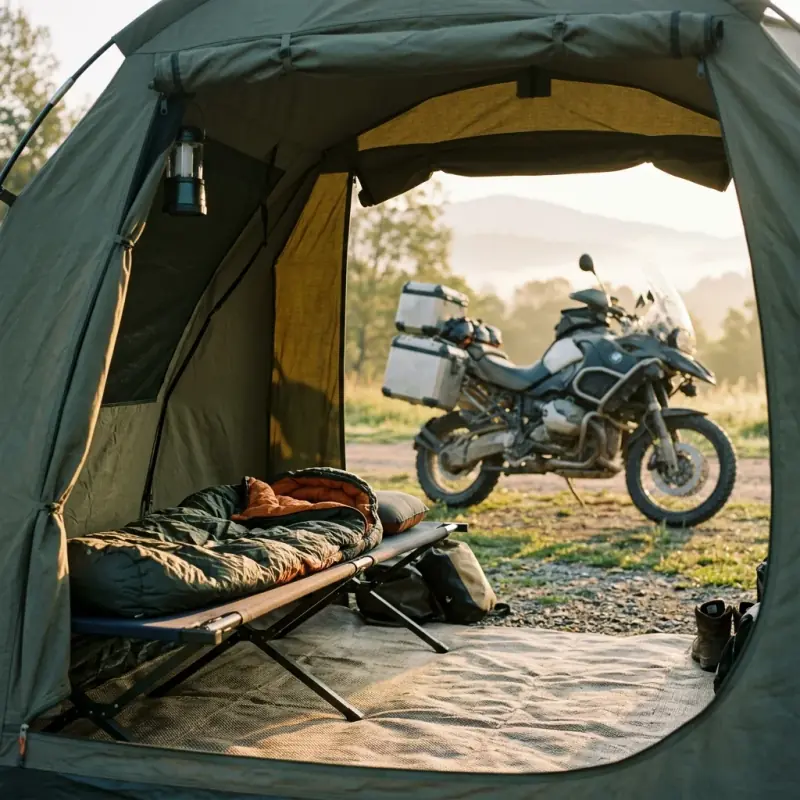
A camping cot gets you off the ground: off the cold, the wet, and the rocks and roots that no pad fully smooths out. It costs pack space and weight that a good sleeping pad doesn’t, though, and for most touring a quality inflatable pad is the better buy.
This guide is for the rider who already knows a pad isn’t enough: the side sleeper, the basecamper, the rider with a bad back or who camps on rough ground, and who wants a cot that still fits on the bike. A cot is one half of the camp-comfort upgrade; the other is a proper camp chair for the hour between dinner and sleep.
Helinox Cot One Convertible
The most refined packable cot: taut bed, 145 kg rating, fits a pannier.
Check Helinox Cot One on Amazon →What Makes a Cot Good for Motorcycle Travel
A motorcycle cot has to pack small enough for a pannier. That rules out the steel-framed fold-in-half cots from the camp store, which are heavy and the size of a folded chair. The cots that belong on a bike are the aluminum, shock-corded designs that break down into a bundle about the size of a rolled tent.
Pack size is therefore the first variable. The Helinox cots pack to 53–55 cm long; that’s the difference between a cot you can carry and one that swallows a whole pannier.
Weight matters less than on foot, because the bike carries it, but cots are heavy relative to pads. 1.2 kg versus 2.2 kg is a real difference when you’re already carrying a tent, bag, pad and stove. Decide whether you’ll use the comfort enough to justify the kilo.
Setup and stability round it out. Some cots go together quickly; others need force to seat tensioned end bars, the trade-off for a taut bed. And the feet matter: more feet, capped and rounded, mean a stable cot that won’t tip on uneven ground or punch a hole in your tent floor.
The cold-from-below catch deserves its own warning, covered in detail later: a cot suspends you in moving air, so below ~15°C you’ll want a pad on top for insulation. Plan for it.
The Cots at a Glance
3 Camp Cots — Side by Side
| Cot | Weight | Pack Size | Max Load | Height | Price |
|---|---|---|---|---|---|
| Editor's PickHelinox Cot One Convertible | 2.1 kg | 53 × 15 × 14 cm | 145 kg | 16.5 cm | $349.95 |
| Helinox Lite Cot | 1.2 kg | 55 × 13 × 13 cm | 120 kg | 12.5 cm | $349.95 |
| Best ValueNaturehike ArmyWild | ~2.3 kg | — | 150 kg | 17 / 38 cm | ~$100 |
Helinox figures are from helinox.com, Naturehike’s from its Amazon listing (packed size not given); prices read 15 October 2026. Helinox lists both cots at $349.95, but Amazon US had the Lite Cot at $244.97 and a Coyote Tan Cot One at $279.97 the same day, so shop around. The Therm-a-Rest LuxuryLite UltraLite Cot, long the lightest cot on lists like this, is no longer on Therm-a-Rest’s store and shows as unavailable on Amazon, so it’s left out.
1. Helinox Cot One Convertible — Best Overall (2.2 kg)

The Cot One Convertible is the cot to start with if you’ve decided you want one. Helinox lists it at $349.95; it weighs 2.1 kg (2.2 kg with the case) and packs to 53 × 15 × 14 cm, which fits a pannier.
What you’re paying for is build and refinement. The DAC aluminum frame is light and stiff, and the end bars lock in with a lever system that keeps the bed taut. The bed sits 16.5 cm off the ground and is 66.5 cm wide; “Convertible” means leg extensions, sold separately, raise it to 38 cm for chair-height entry or storage underneath. It is rated to 145 kg, well above a rider plus whatever gets leaned on it.
The downsides are price and weight. $349.95 is a lot for a place to sleep, and 2.2 kg packed is real mass on top of your pad and bag. Check the width against your tent floor, and put a foam square under each foot on a thin groundsheet.
Disclosure: some links below are affiliate links. If you buy through them we may earn a small commission at no extra cost to you.
Check Helinox Cot One on Amazon →
- DAC alloy frame, lever-locked taut bed
- Packs to 53 × 15 × 14 cm
- 16.5 cm off the ground, 38 cm with leg extensions
- Rated to 145 kg
- $349.95 list, expensive for a sleep surface
- 2.2 kg packed, on top of your pad and bag
- 66.5 cm wide; check it fits your tent
2. Helinox Lite Cot — Lightest (1.2 kg)

The Helinox Lite Cot is the Cot One’s lighter, simpler sibling: 1.2 kg (1.25 kg with the case), packing to 55 × 13 × 13 cm, with the same DAC aluminum frame. Helinox lists it at the same $349.95 as the Cot One, but retailers often sell it for less.
You give up the leg-extension option and some capacity (120 kg vs 145 kg). It sits lower, 12.5 cm off the ground, and the bed is narrower, 58 cm against 66.5 cm. In exchange you save about a kilo and a little pack volume. For a solo rider of average build who wants the lightest cot, the Lite Cot is it; a larger rider, or one who wants chair height, should get the Cot One.
Check Helinox Lite Cot on Amazon →
3. Naturehike ArmyWild — Best Value (~2.3 kg)

The Naturehike ArmyWild is the value pick at about $100 on Naturehike’s Amazon store. The listing gives 7075 aluminum poles, a 300D polyester bed, a 150 kg rating, about 2.3 kg, and two heights: 17 cm for inside a tent, 38 cm with the extra legs fitted. It doesn’t give a packed size, so measure it against your pannier before a trip.
Naturehike makes competent gear that undercuts the big brands. What you give up against the Helinox is refinement and a long track record; keep an eye on the feet against your tent floor or add foot caps. For a rider who wants to try cot camping without spending $350, or who camps a handful of nights a year, it does the core job: a flat, raised bed.
Check Naturehike Cot on Amazon →
The Cold-From-Below Problem (Read Before Your First Cold Night)
The common first-cot mistake is sleeping on it bare on a cold night and waking up freezing. Here’s why: a cot suspends you in moving air. There’s nothing under you trapping a layer of still, warm air the way insulated ground does. So on a cold night you lose body heat from underneath far faster than you’d expect — sometimes colder than just sleeping on a good pad on the ground.
The fix is simple and you should plan for it: put a sleeping pad on top of the cot. A closed-cell foam pad or an inflatable pad with a decent R-value sits on the cot bed and gives you the insulation the cot can’t. This is the standard cold-weather cot setup — cot for the flat, off-the-ground platform, pad on top for warmth.
The rough rule: above ~15°C, a bare cot is fine and the airflow is pleasant on a warm night. Below that, add the pad. Below ~5°C, use a genuinely warm pad (R-value 4+) on top, exactly as you would on the ground. For the pad side of that equation, our best compact sleeping pads guide covers the warm, packable options that pair well with a cot.
Cot vs Pad: Which to Buy
Before you spend $100–350 on a cot, decide whether you need one. For the majority of touring riders, a good inflatable sleeping pad is the better choice. It packs far smaller, weighs a fraction as much, and a modern pad with an R-value of 4+ is warm and comfortable.
A cot earns its place when:
- You camp on wet, rocky, or root-covered ground a lot. The cot floats above all of it.
- You’re a side sleeper who feels the ground through any pad.
- You have back issues that a flat, firm, raised surface helps.
- You basecamp for several nights in one spot, where setup time and pack size matter less.
If none of those are you, put the money toward a better pad and bag instead. If one or more is you, and especially if you’ve already tried a pad and it isn’t working, a cot is a real upgrade. For the rest of the sleep system, the best sleeping bag for motorcycle camping guide and the motorcycle camping gear checklist cover what pairs with whichever you choose.
Disclosure: Some links in this article are affiliate links. If you buy gear through them, we may earn a small commission at no extra cost to you. Every cot on this list was chosen on its published weight, packed size, height and load rating, weighed against owner reviews; none was tested by us.
A note on the prices: list prices read on 15 October 2026 from Helinox US and Amazon US, not live quotes. They vary by region and retailer; the figure on the linked product page is the one that counts.
Frequently Asked Questions
Cot or sleeping pad for motorcycle camping?
For most riders, a good inflatable sleeping pad is the better choice — it packs smaller, weighs less, and modern pads (R-value 4+) are warm and comfortable. A cot earns its place in specific cases: if you camp on wet, rocky, or root-covered ground a lot; if you're a side sleeper who hates feeling the ground through a pad; if you have back issues that a flat raised surface helps; or if you stay in one basecamp for several nights. For a typical touring rider the answer is a pad. The cot is an upgrade for the rider who already knows a pad isn't cutting it for them.
Do camping cots pack small enough for a motorcycle?
The good ones do. The Helinox cots break down into shock-corded poles plus a fabric bed: the Cot One packs to 53 × 15 × 14 cm and the Lite Cot to 55 × 13 × 13 cm, about the size of a rolled-up tent, which fits a pannier. Avoid the steel-framed 'camp store' cots that fold in half: they're heavy and the size of a folded camp chair. Stick to the backpacking-style aluminum cots.
Are cots cold to sleep on?
They can be. A cot suspends you in moving air, so on a cold night you lose heat from underneath faster than you would on the insulated ground. Above roughly 15°C it's a non-issue and the airflow is actually pleasant. Below that, put a foam or inflatable sleeping pad on top of the cot for insulation. This is the standard cold-weather setup: cot for the flat, off-the-ground platform, pad on top for the R-value. Plan for it rather than being surprised by a cold night.
How much weight can an ultralight cot hold?
More than you'd expect. Helinox rates the Cot One to 145 kg and the Lite Cot to 120 kg, and Naturehike lists the ArmyWild at 150 kg, all comfortably above a rider plus gear leaning on it. The thing to check beyond the load rating is the leg design: more feet spread the load, are more stable and are less likely to puncture a groundsheet.
Will a cot damage my tent floor?
It can, if the feet are sharp and concentrate weight on a small area — the classic way to put a hole in a tent groundsheet. Quality ultralight cots use rounded or capped feet that spread the load, and several sell dedicated foot pads. If your cot has hard tube ends, add foot caps or place a small piece of foam under each foot. A footprint under the tent adds another layer.