
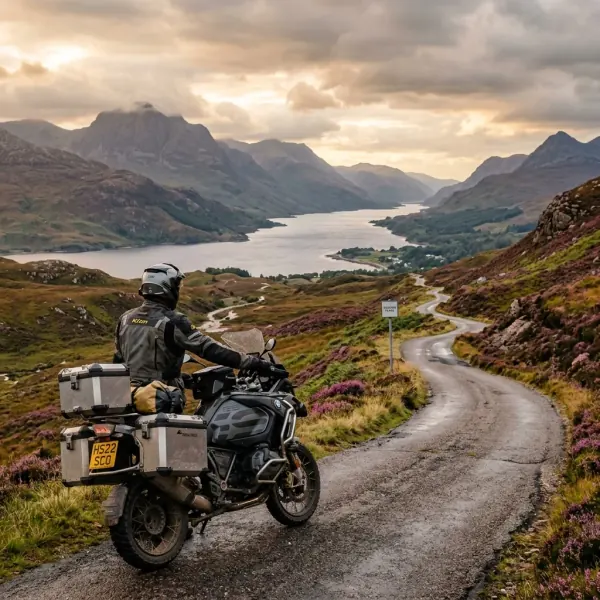
Weather decides an NC500 trip more than anything else. The north of Scotland can rain for days at a time, and a jacket whose waterproofing you have never really tested will wet out at the seams by the second day. The clear hours, when they come, are the reason riders go.
The NC500 — the North Coast 500 — is the route that anchors most foreign riders’ Scotland trips, and for good reason. 516 miles of single-track coast roads, sea lochs, and mountain passes, looping out of Inverness and back. This guide covers the weather, the fuel planning and the sections that earn the miles.
What the NC500 Is
The route was branded in 2015 by the North Highland Initiative to bring visitors to the sparsely populated north of Scotland. It isn’t a single named road but a loop through a network of A-roads and single-track roads, looping from Inverness through Wick, John o’ Groats, Durness, Ullapool, Applecross, and back via the Black Isle.
What makes it work as a motorcycle trip is the roads. The A832 around Gairloch runs in medium-speed sweepers along sea lochs. The B869 north of Lochinver climbs and drops through bog and rock in long runs of tight, blind corners. The Bealach na Bà into Applecross has the greatest ascent of any road climb in the UK.
The route isn’t perfect. The east coast section between Inverness and Wick is long, flat, and visually unremarkable compared to the west. The single-track roads with passing places frustrate riders who want to ride hard. And in peak summer the route gets clogged with motorhomes that struggle to use passing places correctly.
Treat it as a tour, not a fast lap, and it is one of the best weeks of riding in the UK.
The Route at a Glance: 516 Miles Around the Scottish Highlands
| Stage | Distance | What You’ll Remember |
|---|---|---|
| Inverness → John o’ Groats (east coast) | 120 mi | Coastal A9 then A99 north |
| John o’ Groats → Durness | 90 mi | Empty north coast, Smoo Cave |
| Durness → Lochinver | 60 mi | Kylesku, then the B869 coast road |
| Lochinver → Ullapool | 35 mi | Assynt mountains: Suilven, Stac Pollaidh |
| Ullapool → Applecross | 115 mi | Via Gairloch, Torridon and the Applecross coast road |
| Applecross → Inverness | 80 mi | Over the Bealach na Bà, then back to base |
Total: roughly 500 miles on this line by OSRM routing; the official NC500 is quoted at 516 miles, depending on the variations you take. The east coast is the least visually interesting section, and some riders shorten it by joining the loop further north, but it has its moments (Dunbeath Castle, the Whaligoe Steps).
Clockwise or Anti-Clockwise? (This Guide: Clockwise)
Both directions work. This guide rides clockwise, for two reasons, and there’s one good argument for the other way.
First, the route builds. Clockwise gets the long, flat east coast out of the way while you’re fresh and saves the west coast, the reason you came, for the second half of the trip.
Second, Applecross arrives the scenic way. Clockwise you reach Applecross along the coast road from Shieldaig and leave over the Bealach na Bà. The steep hairpins are on the Tornapress side, so you’d be descending them; if you’d rather climb them, ride the pass out and back from Tornapress before you leave.
The argument for anti-clockwise: in Britain you ride on the left, so going that way keeps the sea on your side of the road, and the views closer. If that matters more to you than the build-up, flip the itinerary; the stages work in reverse.
The Must-Ride Sections
Bealach na Bà: The UK’s Most Dramatic Pass
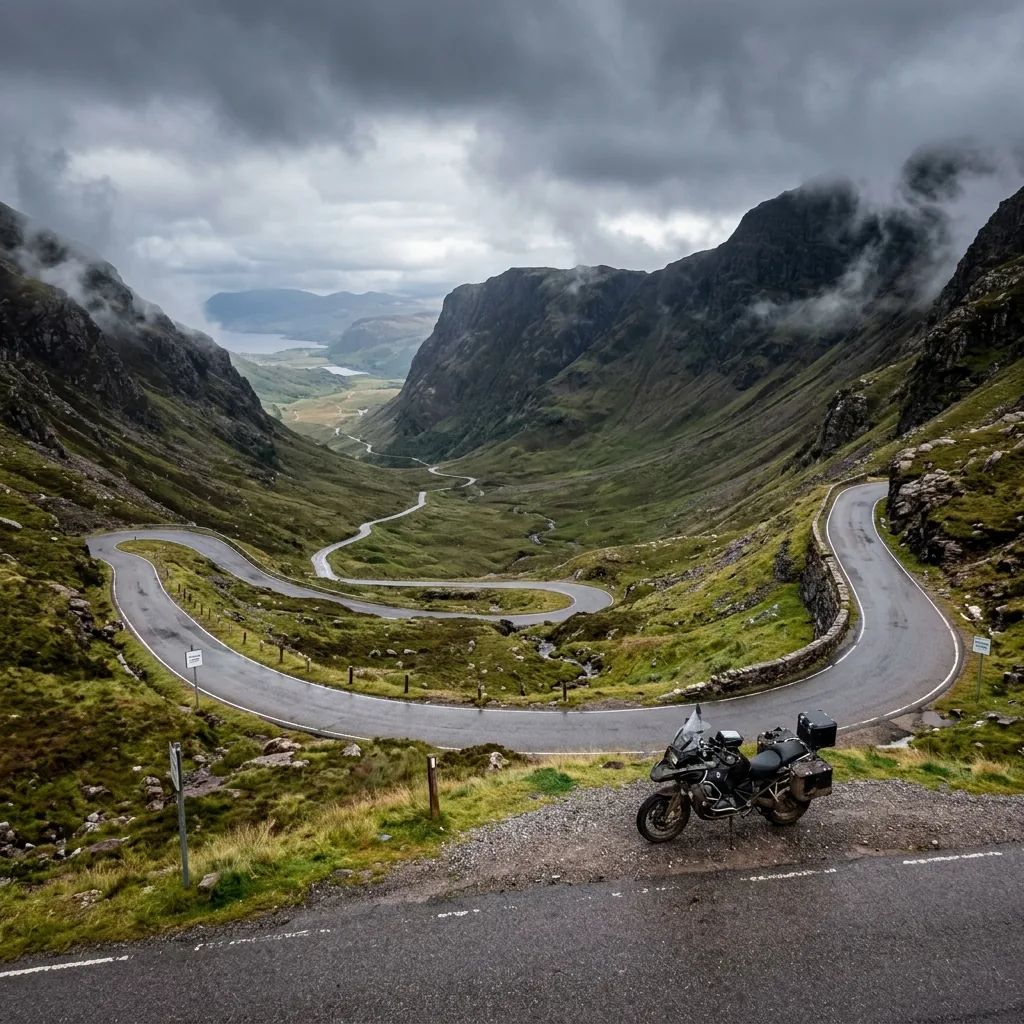
The 11-mile road from Tornapress to Applecross climbs from sea level to 626 metres through tight hairpins, with gradients of up to 20%. Signs at the bottom warn caravans and learner drivers off it. On a bike it is easier than in a car, as long as you are comfortable with tight hairpins on a steep gradient.
Ride it midweek if possible. Weekend traffic includes nervous car drivers who freeze in the switchbacks. Ride it early morning or late evening for the best light. The summit has a small parking area, and the Applecross Inn sits on the seafront at the bottom.
Durness to Applecross: Best Scenery on the Entire Route
The stretch from Durness south along the A838, A894, A837, A835 and A832 through Lochinver, Ullapool, and onto Applecross is where the NC500 earns its reputation. The road threads between sea lochs and mountains that rise almost straight from sea level: Stac Pollaidh (612 m), Suilven (731 m) and An Teallach (1,062 m).
The B869 between Kylesku and Lochinver is the best stretch on the route. Single-track, with passing places, past Drumbeg, Stoer and the sandy beach at Achmelvich. It is slower than the main road and easy to skip; don’t.
Cape Wrath: The Northern Extreme
Cape Wrath is the northwesternmost point of mainland Britain. Reaching it requires a ferry across the Kyle of Durness and then a minibus or a long walk of about 11 miles on a road through a military training area; check the ferry is running before you plan around it. Motorcycles can’t make the crossing. It’s foot passenger ferry only.
If you can spare half a day, do the ferry and minibus trip. The lighthouse at the cape is the end of mainland Britain. If you can’t spare the time, don’t feel guilty skipping it. The NC500 doesn’t actually go to Cape Wrath; the official route stays on the public road.
NC500 Motorcycle Packing Checklist
The short list that handles most of what Scotland will throw at you.
- Waterproof jacket and trousers
- A fuel plan: few stations, short hours in the northwest
- Offline maps (OsmAnd or similar)
- Accommodation booked for summer
- Tyre plug kit
- First aid kit for the remote sections
Waterproofs are non-negotiable. The weather in the north-west changes fast, and a bright morning is no promise for the afternoon. The right kit is a fully waterproof outer jacket and trousers (Klim, Rev’It, or Aerostich), worn over a layered base. Not a “water-resistant” textile suit that wets out after an hour. Not a flapping ponchotype add-on. Real, sealed-seam, waterproof riding gear.
Disclosure: some links below are affiliate links. If you buy through them we may earn a small commission at no extra cost to you.
Check Waterproof Touring Gear on Amazon →
Fuel discipline matters. Fill every chance you get in the northwest. The next station might be closed, might be Sunday, might be 40 miles further than you thought. A 5L spare fuel canister strapped to the bike adds peace of mind for sub-150-mile-range bikes.
Wild Camping in Scotland: The Legal Reality
Scotland’s Land Reform Act 2003 created a right to camp on most unenclosed land, and the Scottish Outdoor Access Code sets out how: a small tent, in small numbers, for no more than two or three nights in one place, well away from buildings and roads, leaving no trace and keeping out of enclosed fields of crops or animals.
The part riders get wrong is the bike. Access rights don’t include motor vehicles. The right covers you on foot, not riding up a track or across a moor to pitch beside the motorcycle. The Code’s advice is to park in a car park, have a backup if it’s full, and walk to your camping spot. In practice:
- Park legally — not in a passing place, a field gateway or a layby used as a campsite
- Walk your tent away from the road; a pitch beside the bike in a roadside pull-off isn’t wild camping under the Code
- Loch Lomond and the Trossachs National Park, far south of the NC500, restricts camping in some zones in season
- If you want to sleep next to the bike, use a campsite; the route has plenty, and they fill in summer
The midges in summer are the other problem — bring permethrin-treated clothing and a midge net for your head if you camp June through September.
Best Time to Ride the NC500
Late May to mid-June. The best window. Sunset is around or after 22:00 by June, and in the far north the twilight lasts long after that. Temperatures typically 12-18°C, wildflowers along the verges, and the midges only starting.
September. The second-best window. Stable autumn weather, heather in bloom on the moors, sea temperatures still warm enough for the brave to swim. Midges declining. Accommodation easier to find. Daylight shorter (sunset around 19:30) but enough for a full riding day.
July-August. Avoid if you can. Accommodation books out 6 months ahead, prices peak, motorhomes clog single-track roads, and midges peak. Possible if you’re flexible and willing to wild camp or book very early, but the experience suffers.
October-April. Possible on the A-roads. The narrow B-roads in the northwest can ice over. Daylight is short (sunset around 15:30 in Inverness in December). Accommodation thin as many tourist businesses close. A different trip; quieter, more atmospheric, riskier.
Fuel and Logistics Planning
The fuel map of the NC500 is the single planning item most often underestimated. In the northwest, fuel is in a handful of villages:
- Ullapool, the largest town on the west side
- Lochinver
- Kinlochbervie
- Durness
- Tongue
Outside Ullapool these are small village stations; opening hours are short, some close on Sundays, and hours change by season, so check them before you set off each day.
The run from Durness south to Ullapool is the stretch to plan, with Kinlochbervie and Lochinver as the intermediate options, both with restricted hours and not always Sunday-open. Fill at Durness if it’s open, and again at Lochinver. Plan to arrive at Lochinver with at least 50 miles of range remaining.
For accommodation, book 3-4 months ahead for May-June, 6 months ahead for July-August. Wild camping is a legitimate plan B but should not be plan A in changeable weather.
Related Guides
For the Irish sibling to this route — the same single-track-and-sea-cliff riding over a much longer coast — see the Wild Atlantic Way motorcycle route guide. For longer European routes that connect from the NC500, see Trans-Euro Trail for beginners. For the tools and spares worth carrying on a remote route, see the field tool kit checklist.
Disclosure: Some links in this article are affiliate links. If you buy gear through them, we may earn a small commission at no extra cost to you.
Frequently Asked Questions
When is the best time to ride the NC500?
Late May through mid-June, or September. Late spring gives you long daylight (sunset around or after 22:00 by June), wildflowers, and more accommodation left than in high summer. September gives you stable weather, the heather in bloom on the moors, and fewer midges than peak summer. Avoid July-August — accommodation books out 6 months ahead, single-track roads clog with motorhomes, and prices spike. Winter is technically possible on the A9 and A99 but the northwest's narrow B-roads become risky in ice and snow.
Clockwise or anti-clockwise for motorcycles?
Either works; this guide rides it clockwise. Clockwise gets the long, flat east coast done first and builds toward the west coast, the best of the route, instead of front-loading it. Anti-clockwise has one real argument: in Britain you ride on the left, so going that way keeps the sea on your side of the road. On the Bealach na Bà, the steep hairpins are on the Tornapress side, so if you want to climb them rather than descend them, ride the pass out and back from Tornapress.
What's the realistic fuel range I need?
Plan on filling at every chance in the northwest. Ullapool to Durness is around 70 miles by the main road, the village stations in between keep short hours, and some close on Sundays. A bike with a 200+ mile range handles the route without anxiety. Smaller-tank bikes (250-400cc with 150-mile range) work if you fill at every village and don't skip a station thinking the next one will be open.
Can I really wild camp anywhere in Scotland?
On foot, on most unenclosed land, yes: the Land Reform (Scotland) Act 2003 and the Scottish Outdoor Access Code allow lightweight camping in a small tent, in small numbers, for two or three nights in one place, well away from buildings and roads. The catch for riders is that access rights don't include motor vehicles. You can't ride onto a track or moor to pitch next to the bike; park legally, in a car park where there is one, and walk to your spot. Laybys are for parking, not camping, and Loch Lomond and the Trossachs National Park restricts camping in some zones in season. The NC500 is well north of that park.
How long does the NC500 really take on a motorcycle?
5 days minimum, 7-10 days to actually enjoy it. The 516-mile loop sounds like a 2-day blast on a sport bike. It isn't. Single-track roads with passing places limit your speed to 30-45 mph average. Frequent stops for views, ferry crossings, and weather pauses add time. Riding the NC500 in 3 days means seeing the road but not the place. Give it a week.